What to Expect on a Freediving Course in Dahab
Most people arrive at a freediving course not quite knowing what they’ve signed up for. They know they want to try it. They’ve seen the videos. But what actually happens on the day, hour by hour, pool to open water, is usually a mystery until they show up.
This is what a beginner freediving course looks like at The Gate Freediving in Dahab. No surprises.
One day, three phases
The beginner course runs over two and a half days. Each day follows the same shape: theory first, then pool, then open water. That order is deliberate.
Theory is not a formality. It’s where you learn why your body behaves the way it does underwater: what happens to your lungs, your heart rate and your ears as you descend. Understanding that makes everything that follows feel less strange and more manageable. We take as long as we need. There’s no clock on it.
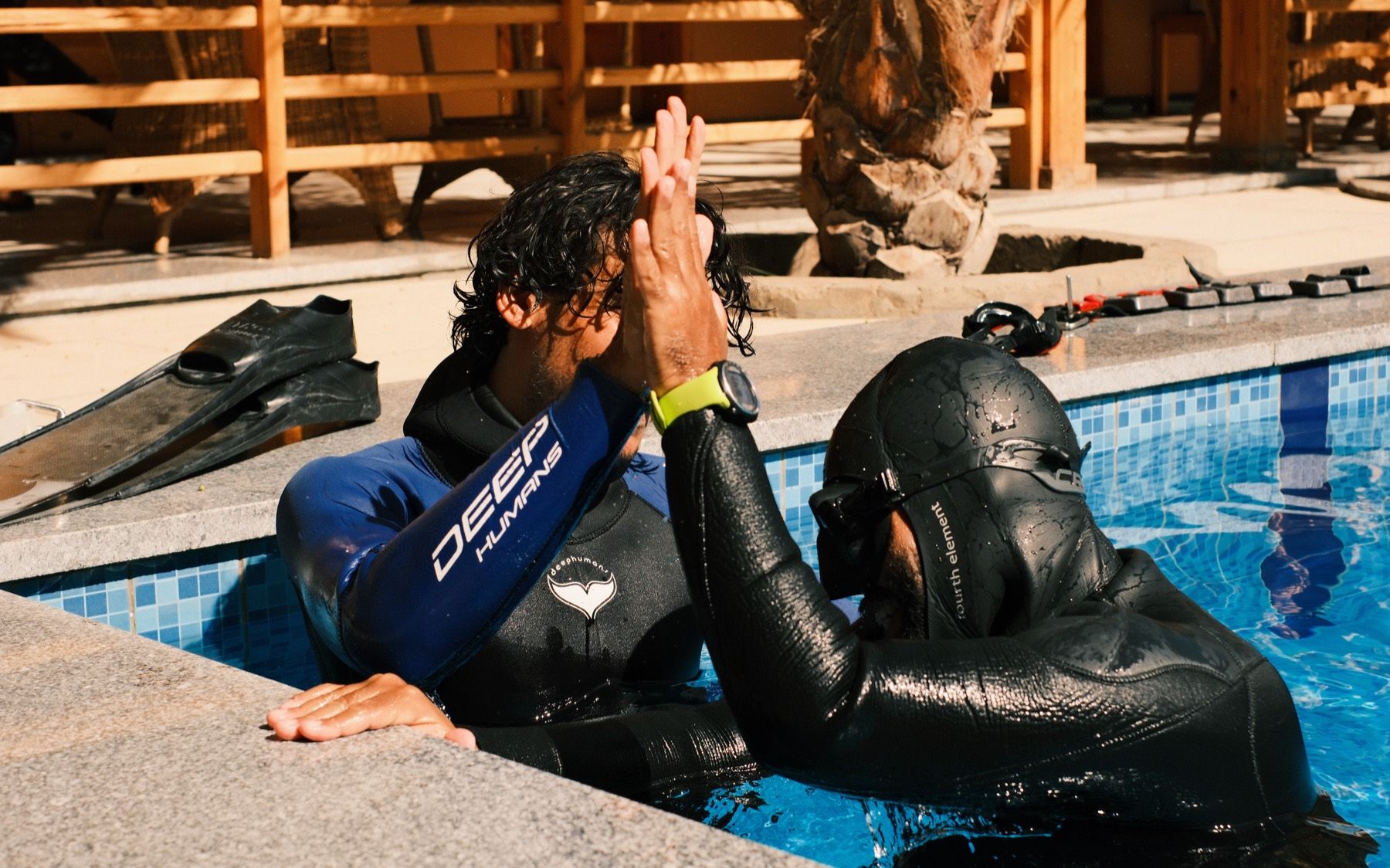
The pool comes next. This is where the techniques you just learned become physical: static apnea, finning, duck dives, the basics of equalisation. Our pool is 25 metres and used only by our students, so you’re not sharing lanes with anyone else.
Open water is the last part of the day. By the time you get there, you already know what you’re doing. It’s not a jump into the unknown, it’s a continuation of something you’ve already started.
The morning: theory at the centre
Theory happens at The Gate Freediving centre, based at The Gate Hotel on Mashraba Street. You’ll be in a proper classroom, not a beach bar with a whiteboard. Air conditioning, space, equipment on hand.
The topics: the physiology of breath-holding, equalisation, safety, the buddy system, and an introduction to what you’ll practise in the water. It flows naturally, because each topic connects to the next.
One practical note: don’t eat a full breakfast before you dive. A heavy meal means your body is busy digesting when you want it relaxed, and coffee raises your heart rate, which doesn’t help. Something small and light is fine. You’ll eat properly after the pool session.
The pool: where it starts to click
The pool is where most people have their first real freediving moment.
Static apnea usually surprises people the most. You’re floating face-down, holding your breath, and at some point you realise you’ve been under for longer than you thought possible. That gap between what you expected and what you actually managed is the moment most people remember. It’s quiet. That’s the point.
Equalisation gets its first serious practice here too. Most people worry about it beforehand and manage it sooner than they expected. We go through it step by step, in the water, until it feels natural. For the people it does not come to, it is worth taking apart on its own, and that is what equalization coaching is for.
Open water: more than you expected
Open water sessions are at the Lighthouse, a five-minute drive from the centre. We drive there with the buoy, walk into the water from the shore, swim out a short distance and anchor the line. Every open water dive happens along that line. Shore entry, no boat.
The water in Dahab sits between 22 and 28 degrees depending on the time of year. That matters more than people realise. Cold water triggers a stress response before you’ve even started. Warm, calm water does the opposite. It’s genuinely easier to relax here than in most other places, and relaxation is what freediving depends on.
What surprises people most at this stage is how much they can already do. The pool built the foundation; the open water is where you find out what it’s worth. Most students reach depths on their first open water session that they weren’t expecting.
We almost always work one instructor to one student. When it’s busier we keep groups as small as we can. Your instructor knows your name, knows how your morning went, and knows where you got stuck and where things clicked.
The equipment
All equipment is provided: wetsuit, mask, fins, buoy, line. If you have your own mask, bring it. But you don’t need to bring anything, just yourself, water and sunscreen.
A few practical things
Alcohol the night before: nobody’s going to tell you what to do with your evening. But alcohol affects your recovery and your ability to relax. A beer with dinner won’t ruin anything. Several drinks two nights running probably will slow things down. You’ll feel the difference yourself.
Nerves: almost everyone arrives with some. The most common one is “what if I panic underwater.” In practice, the course is built so that you never end up deeper than you’re ready for. Every step is introduced in a context where you already feel comfortable, and the anxiety most people imagine rarely shows up.
What the course doesn’t prepare you for
The view. Most people spend a moment on the surface at the Lighthouse just looking down before they dive. Visibility in Dahab regularly goes past 30 metres. For people who have never freedived before, it’s unlike anything they’ve seen from the surface. That part is hard to put in a course description. It’s also the part most people mention afterwards.
After the course
You leave with your AIDA 2 or SSI Level 1 certification, internationally recognised, valid to dive with a buddy to 20 metres. It doesn’t expire.
Most people leave with more questions than they arrived with. That’s usually a good sign. The course answers whether you can freedive. The questions that come after are about where you want to take it. If you want to keep going, training sessions at the Lighthouse or the Blue Hole are open to certified divers, and the advanced course is there when you’re ready. Or you come back next year. That happens a lot.
Any questions about whether the course is right for you, just get in touch. We’ve probably heard it before, and we’re happy to talk it through.
Frequently asked questions
Do I need any experience to do a freediving course in Dahab?
No. The beginner course is designed for complete beginners. You need to be able to swim at least 200 metres non-stop and be at least 18 years old. No freediving experience or prior breath-hold training required. The course starts from zero.
What happens on the first day of the course?
The first day starts with theory at the centre: physiology, equalisation, safety and the buddy system. After theory you go into the pool for your first water sessions: static apnea, finning, duck dives and basic equalisation. Open water starts on day two. You will not be in the open water before you are ready for it.
How long does a freediving course in Dahab take?
The beginner course runs over two and a half days. A typical day starts around 8 or 9 in the morning and finishes around 3 or 4 in the afternoon. The pace adjusts to the group: if something needs more time, it gets more time.
What equipment do I need to bring?
Nothing. All equipment is provided: wetsuit, mask, fins, buoy and line. If you have your own mask, bring it. Otherwise just bring yourself, water and sunscreen.
Is freediving in Dahab suitable for beginners?
Yes, Dahab is one of the best places in the world to learn. The water sits between 22 and 28 degrees depending on the season, visibility regularly exceeds 30 metres, and there is almost no current. Shore entry, no boat. The conditions make it genuinely easier to relax and progress than most other locations.
What certification do I get after the course?
You receive either an AIDA 2 or SSI Level 1 certification, both internationally recognised and valid to dive with a buddy to 20 metres. You choose which agency you prefer when you book. The certification does not expire.
Emilio & Liam